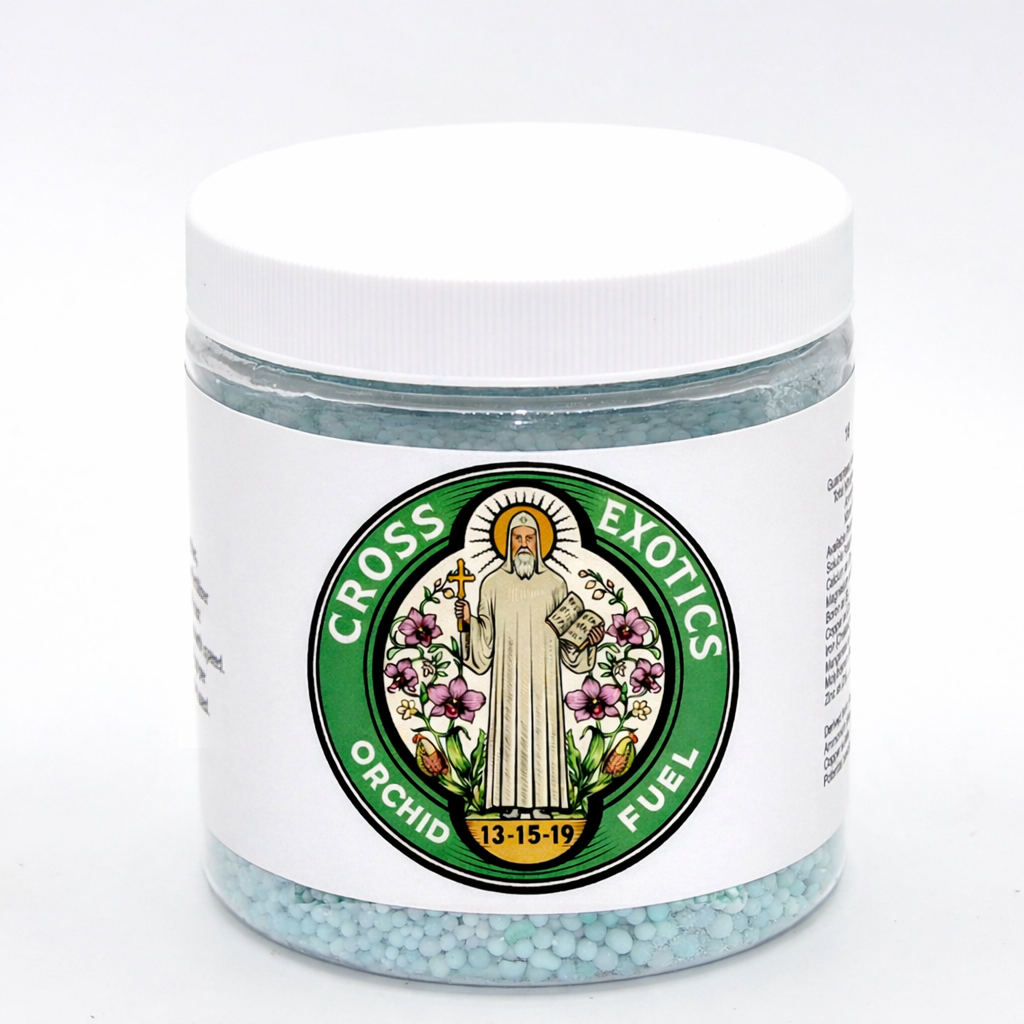
Use at 3/4 tsp per Gallon (1.5 g per L).
The best orchid fertilizer available! This is our own fertilizer formulated by commercial orchid grower Xavier G. de Loubresse for Dendrobium, Paphiopedilum, Phalaenopsis, and other orchids. It quickly greens up plants, even on slower species, making long lasting deep green shiny leaves. It also helps with blooming and many growers have had their stubborn bloomers flower shortly after using this fertilizer. It is a complete NPK fertilizer with Calcium & Magnesium and is safe to use even on fertilizer sensitive species due to the Ammonium nitrogen added.
This fertilizer also works great for the pitcher plants, Nepenthes, and Amorphophallus. It is very low urea - Urea Nitrogen can be very good for orchids but tends to be too strong for Nepenthes, causing pitchering to stop. The higher levels of micronutrients like Molybodenum also increases growth speed in all three plant groups, and for Amorphophalus it prevents tuber rot from developing in difficult species like pendulus and gigas.
The fertilizer is an easy to use water soluble blend that is dissolved and watered into the substrate. This gives an even fertilization when compared with slow release pellets. We always recommend soil fertilizing since orchids can have difficulty properly absorbing low mobility nutrients via the leaves.
For Aroids & Begonias try out our Green Fuel.
The difference:
There is 3 primary forms of Nitrogen used in fertilizers, Nitrate, Ammonium, and Urea. Most fertilizer research has been for crop plants which typically prefer majority Nitrate, a negative anion that is easily washed out from soils unlike positive cations like Ammonium which are held more strongly be soil CEC. As many orchids are epiphytes or from highland areas, nitrate tends to be washed out of the root zone very quickly from the rainfall, with primarily Ammonium nitrogen remaining. Thus many orchids are adapted and prefer a fertilizer that includes a portion of Nitrogen supplied as Ammonium, typically around a third to half of the total supplied N.
The micronutrient ratios for vegetables is also much lower than ideal for orchids. Crop plants generally are grown in very fertile soils with high macronutrient levels and low micros, with Iron being supplied in the highest ratio of them. However in many tropical areas the micronutrient most commonly prevalent in soils is Manganese and the ratio of macro to micro is less far apart. Not supplying sufficient amounts of the micronutrients typically results in chlorotic new leaves, paleness, and often stunting.
Due to the prevalence of research on vegetables however, many orchid fertilizers are increasingly based on it despite the differences between the two plant groups and their respective environments. Steadily as a result we see fewer impressive orchid collections and orchids today tend to be more dull and smaller than orchids pictured in the AOS awards a couple decades ago. The difference of course was the switch from ammonium based fertilizers to all nitrate fertilizers.
Commercially some Dutch nurseries tried to commercially grow orchids with all nitrate, however after poor results they went back to their old formulas. Still today as a result, commercial production in the Netherlands uses ammonium/urea based fertilizers with some nitrate. Other nurseries like Borneo Exotics uses a 4:7 ratio of nitrate to ammonium; the German nursery Wistuba uses a 6:5 ratio. Nitrate is often used in a good proportion still to keep the substrate from overly acidifying.
Our fertilizer balances these ratios, supplying about a third of total N as ammonium/urea and also has adjusted micronutrients, allowing fast growth without root burn. Added Molybodenum allows the plants to reduce nitrates within the leaf efficiently. The Phosphate level buffers soil pH and increases root growth and the Potassium is critical for strong flowering. It's time to start growing your plants faster and better, the results of our fertilizer speaks for itself in the photos - incredibly green plants.
13-15-19 ratio. 25 lb size. Select free shipping at checkout.